

News & Updates
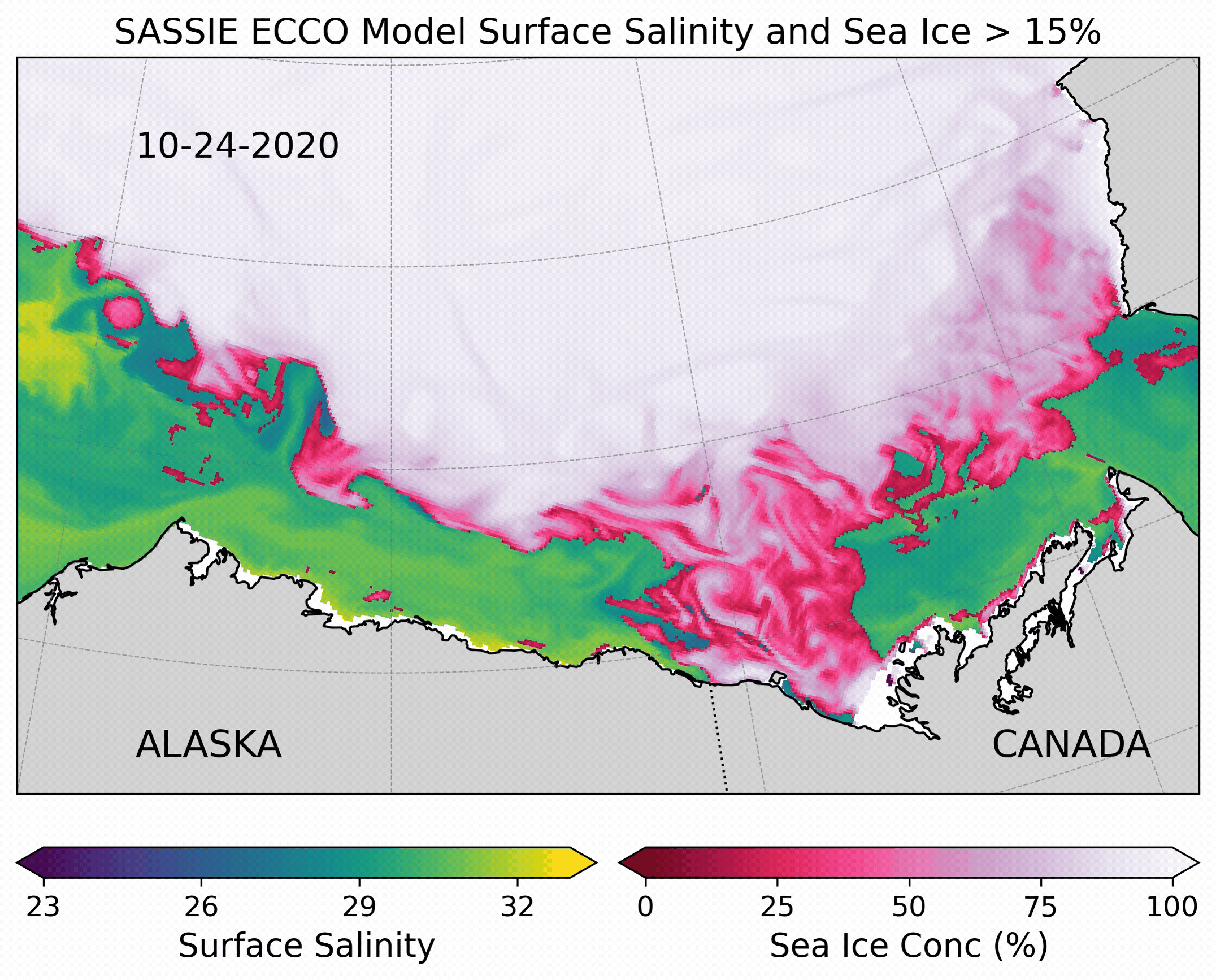
In 2022, NASA launched a field campaign in the Beaufort Sea to study links between upper ocean salinity and fall sea ice formation. Researchers leading the Salinity and Stratification at the Sea Ice Edge (SASSIE) campaign hypothesized that sea surface salinity anomalies generated by summer sea ice melt are an important predictor for fall sea ice formation. In support of this program, a pan-Arctic coupled sea ice-ocean model was developed from the ECCO (Estimating the Circulation and Climate of the Ocean) project. Known as the SASSIE ECCO model, this seven-year simulation (2014-2020) is configured at a high resolution, with an average horizontal grid spacing of 3.5 km and 90 vertical levels.
Original NASA Earthdata Story
While satellite data provide observations of Arctic sea ice concentration (SIC) and salinity at large spatial and temporal scales, ocean models enable researchers to investigate the ocean interior. Accordingly, the SASSIE ECCO model was used alongside remotely sensed observations of SIC and sea surface salinity to test the SASSIE hypothesis in the Beaufort Sea. This integrated approach provides a powerful framework to evaluate how ocean salinity influences the timing and extent of Arctic sea ice.
Major Findings
A recent study shows how freshwater discharge from the Mackenzie River helps sea ice form earlier in the eastern Beaufort Sea by increasing salinity stratification near the ocean surface. The Mackenzie River is the largest North American source of freshwater to the Arctic Ocean, and it strongly influences the structure of the upper ocean in this region.
In the Arctic Ocean, layering of the upper ocean is mainly controlled by salinity. As freshwater from the Mackenzie River spreads across the Beaufort Sea, it forms a lighter, fresher layer at the surface that floats on top of warmer, saltier water below. This layering — known as salinity stratification — acts like a barrier between the surface and deeper water. Because the fresh surface layer does not mix easily with the warmer water underneath, heat from below cannot reach the surface as efficiently. As a result, the surface cools faster, allowing sea ice to form earlier than in nearby areas with saltier, better-mixed water. The early ice that forms over the Mackenzie River plume creates an “ice bridge” connecting the coast to the offshore pack ice, with open water remaining to the east and west.
This ice bridge is consistently observed in satellite observations of SIC and in all years of the SASSIE ECCO simulation (see animation). Analysis of the model shows that sea ice forms approximately three weeks earlier over the Mackenzie River plume than in neighboring waters to the east and west. The model further reveals that changes in the freezing point of seawater explain only a small part of this difference (1 to 2 days), while increased salinity stratification is the main reason.
By combining satellite observations with a high-resolution coupled ocean-sea ice model, this study provides evidence that freshwater runoff from the Mackenzie River plays a critical role in controlling the timing of sea ice formation in the Beaufort Sea. The results support the SASSIE hypothesis that fresh surface layers strengthen upper-ocean stratification, reduce vertical mixing, and promote earlier ice freeze-up. As regions of the Arctic Ocean freshen from increased river discharge, precipitation, and sea ice melt, incorporating SSS observations to models could improve SIC predictions that are relevant to ecosystems, coastal communities, and marine navigation.
NASA Earthdata Links
SASSIE ECCO Ocean and Sea-Ice Surface Stress - Daily Mean llc1080 Grid (Version 1 Release 1)
Layered Stories of Salt & Ice StoryMap