

Meeting Documents
Isopycnal Stirring and Eddy Advection in the Eastern Tropical Pacific
Presented at: Ocean Sciences Meeting 2026
Abstract
Isopycnal stirring, usually parameterized as a horizontal diffusivity KH in models, is important in determining the distribution of water masses and tracers in the ocean. Model outcomes like large-scale ocean circulation and the climate are sensitive to the choice of this parameterized diffusivity - making it important to capture the spatiotemporal variability of this parameter in the ocean for improving the accuracy of climate models. Cole et al. (2015) estimated this diffusivity on a global scale via a mixing length framework - utilizing salinity anomalies, being a proxy for spice anomalies, computed from ARGO profiles and combining these observed fluctuations with velocity fluctuations from the ECCO2 state estimate to get diffusivity values. We perform this analysis in the eastern tropical Pacific - a region affected by strong seasonal trans-isthmic jets known as the Tehuantapecer and associated mesoscale eddy formation . Because these eddies are water-trapping, we investigate the observed anomalies to separate the contribution of smaller-scale eddy stirring and larger-scale eddy advection to get a more accurate eddy diffusivity estimate corresponding to these (O(100 km, 1 month)) length and time scales. We also investigate the seasonality and spatial distribution of horizontal diffusivity estimated via the aforementioned mixing length framework.
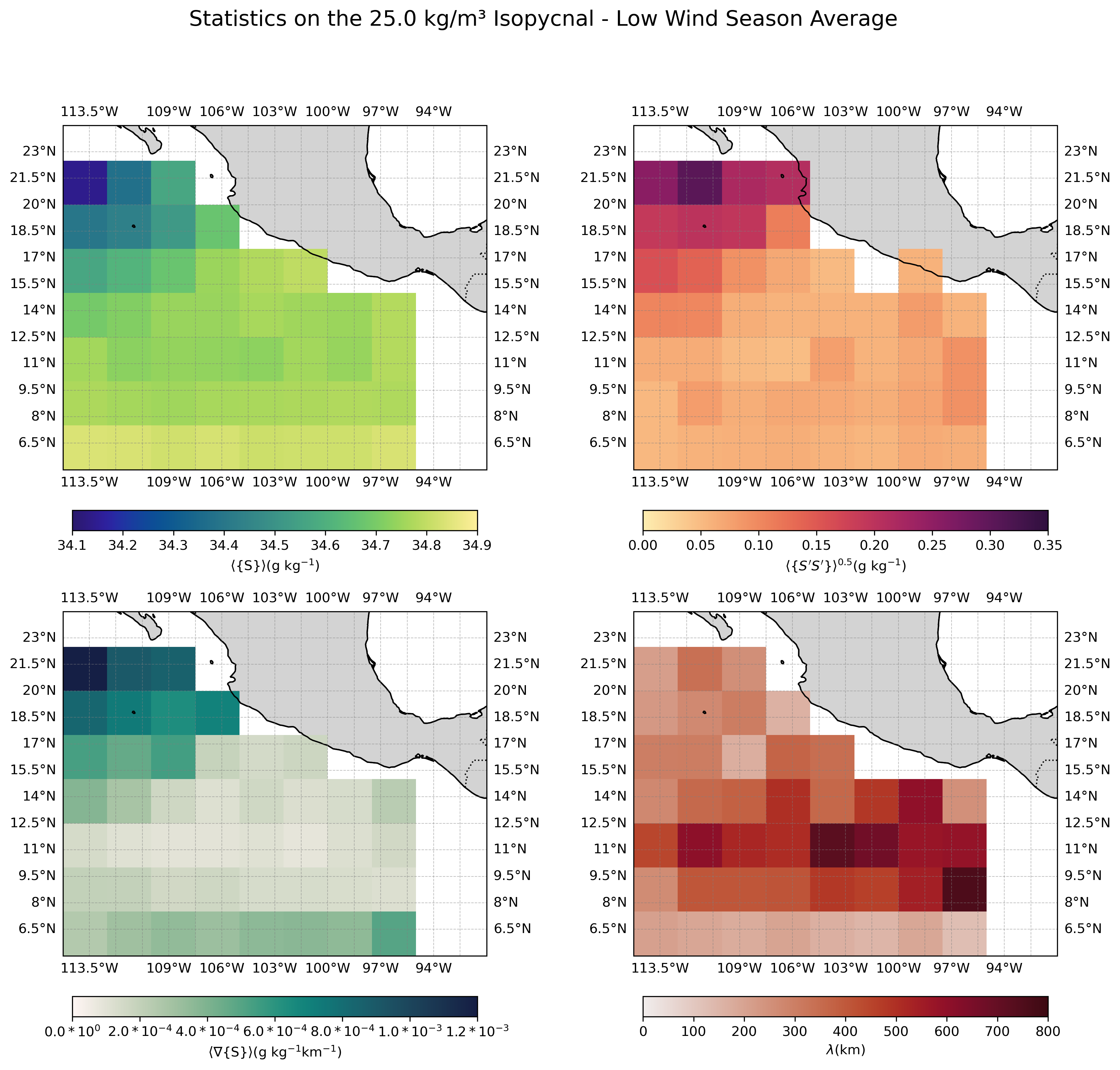
Plain-language Summary: It is important to quantify the role that unresolved processes play in the distribution of particles, dissolved matter, temperature, salt, oxygen etc. in the ocean. Ocean models usually incorporate these processes via a diffusive term in the evolution equation for the aforementioned quantities, which is sensitive to the constant used - the horizontal diffusivity. Thus, identifying the spatiotemporal variation of this horizontal diffusivity at corresponding length and time scales is critical for accurately modeling the evolution of these quantities. Previous observational analysis performed by Cole et al. (2015) constrained this horizontal diffusivity across the globe via utilizing a mixing length framework. We extend this analysis to the eastern tropical Pacific seasonally and at higher resolution, in the presence of large vortices called mesoscale eddies. Because these eddies can carry water along with them, we further investigate the role that this advection may play in observed anomalies in profiles in the region to separate larger-scale eddy advection from smaller-scale stirring/mixing in computing the horizontal diffusivity.
View Document (OSM26) »